Chronic Pelvic Pain in Women: Shockwave Therapy Data

Pelvic pain and sexual dysfunction are among the most persistently undertreated conditions in urology and gynaecology. Pharmacological options are limited, and surgical approaches are often disproportionate to the underlying pathology.
Female sexual dysfunction (FSD) covers disorders of desire, arousal, orgasm, and sexual pain — conditions that share vascular, hormonal, and nociceptive mechanisms and are consistently underreported in clinical encounters, in part because women often expect a clinician to raise the subject first. Genito-pelvic pain and sexual health conditions in women remain comparatively understudied: expert testimony to a 2024 NIH women's health research workshop pointed to markedly fewer published studies on vulvar and genito-pelvic pain than on comparable conditions in men. Chronic pelvic pain syndrome (CPPS) sits at the centre of this picture and carries the most developed shockwave therapy evidence discussed here; vestibulodynia is where controlled data in women is only beginning to appear.
Evidence for shockwave therapy in female sexual dysfunction is still early-stage. It is best developed for CPPS, though the controlled trials to date are in male populations; a sham-controlled trial specific to women exists only for vestibulodynia, and remains a single early study. The vascular and nociceptive mechanisms involved are shared across sexes, but confirmatory trials in women have not yet been conducted.
Chronic Pelvic Pain — the overlooked dimension
Chronic Pelvic Pain Syndrome (CPPS) is one of the most common presentations within the FSD spectrum. It is defined as persistent pelvic discomfort or pain that lasts over six months, in the absence of identifiable infection or other obvious local pathology. Although this syndrome is shared by urology and gynecology, with parallel diagnostic criteria and many of the same mechanistic drivers, chronic pelvic pain is more common in women.
Chronic pelvic pain often comes along with, or drives, sexual dysfunction, and persistent pelvic discomfort is strongly associated with secondary reductions in desire. The two conditions sustain each other in a well-characterised cycle: pain disrupts sexual function, which in turn compounds distress, which sensitises pain perception further.
Current treatments are predominantly oriented towards symptom management. Multidisciplinary options include analgesics and anti-inflammatories, pelvic floor physiotherapy, and antibiotics where infection plays a causative role. When conservative treatment does not bring relief, surgery is considered a last resort. No single intervention reliably resolves the condition.
Female sexual dysfunction, and the biology behind it
Female sexual dysfunction is a clinical umbrella covering any phase of the sexual response cycle: disorders of sexual desire and arousal, orgasmic disorders, and sexual pain and penetration disorders. Each has its own diagnostic criteria and its own treatment literature, which is one reason FSD remains difficult to manage systematically. What unites these conditions is the cyclical nature of the sexual response cycle: a problem in any one of these areas frequently triggers a problem in another.
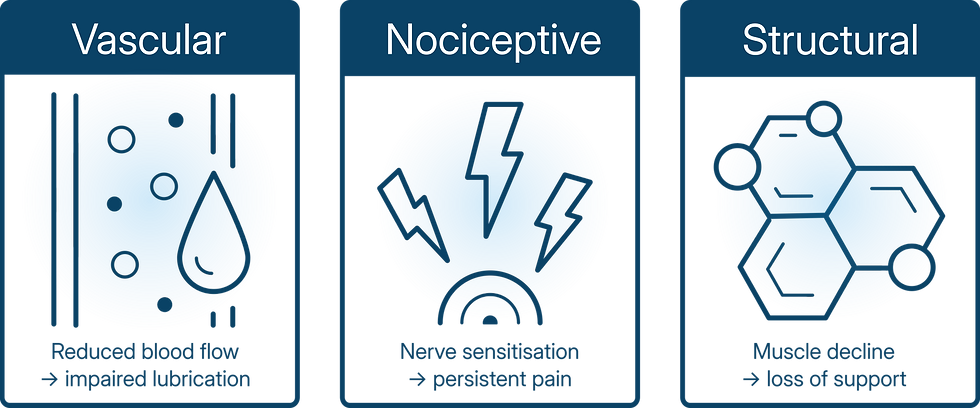
Three biological mechanisms are most often implicated. The first is vascular. Blood flow to the genitourinary structures — clitoris, labia, vaginal wall — determines the quality of physiological arousal, and reduced genital blood flow directly impairs lubrication and clitoral engorgement. This is the same vascular-insufficiency mechanism that drove the development of low-intensity shockwave therapy for erectile dysfunction.
The second is nociceptive. Chronic pain conditions, including vestibulodynia and CPPS, involve peripheral sensitisation of vulvar or pelvic nociceptors. Over time, central sensitisation develops, which sustains the pain independently of the original trigger.
The third is structural. Pelvic floor integrity — the competence of the urethral sphincter, the tone and resilience of the levator ani musculature — deteriorates with age, hormonal change, and the mechanical effects of childbirth.
FSD is associated with high levels of personal distress, relationship strain, and quality-of-life impairment across every decade of adult life.
What the evidence currently shows
The most developed evidence base sits with chronic pelvic pain syndrome. A 2021 systematic review and meta-analysis in male CP/CPPS patients found that low-intensity shockwave therapy produced significant symptom improvement at 12 weeks. [1] The evidence base is from male populations; large controlled trials in female CPPS patients have not yet been conducted, though the vascular and nociceptive mechanisms involved are not sex-specific.
Early investigational evidence is beginning to accumulate for related female conditions. For provoked vestibulodynia, a sham-controlled trial in 32 women found statistically significant pain reduction at one and three months post-treatment.
A 2024 chart review examined outcomes with a focused electrohydraulic shockwave device in patients diagnosed with hormonally-mediated vestibulodynia (HMV) — a distinct subtype characterised by androgen insufficiency affecting vestibular tissue. It represents an early case series using focused electrohydraulic shockwave therapy in this population.
The biological logic connecting these conditions is coherent. The evidence catching up to it is the work of the next research cycle.
The mechanisms behind shockwave therapy's use in female sexual and pelvic health conditions — vascular insufficiency, nociceptive sensitisation, and structural tissue change — are the same processes the therapy has been shown to address in other anatomical contexts. CPPS is where the evidence is most developed; vestibulodynia is where it is beginning to grow.
Disclaimer
This content is intended for qualified healthcare professionals and is provided for informational and educational purposes only. It does not constitute medical advice. Clinical decisions must be made by a qualified healthcare professional based on the individual patient's circumstances.